Why the website became a zombie
Why the website became a zombie
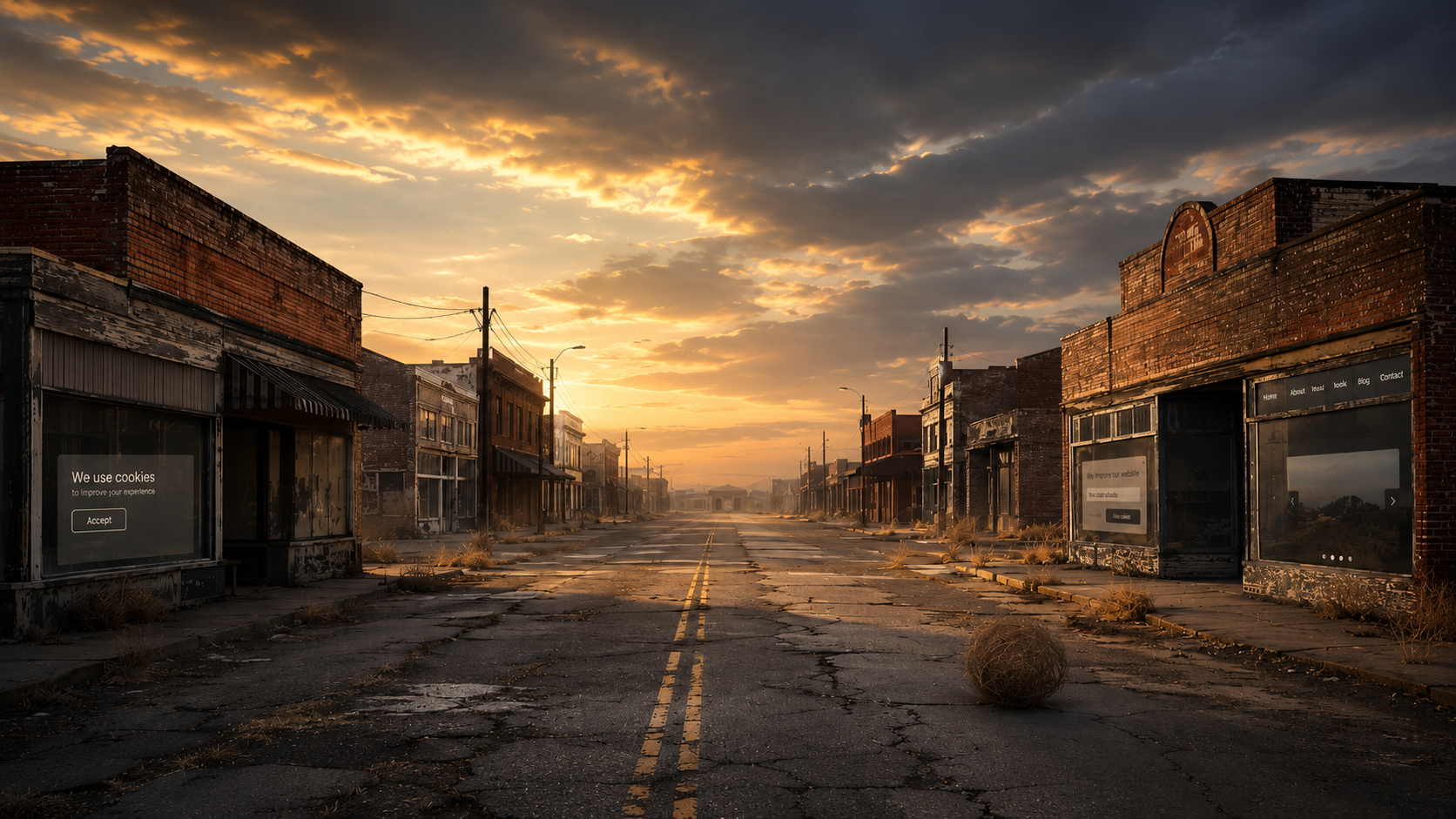
Last night, while you were sleeping, a loyal customer visited your company's website.
She stayed with you last spring: the quiet room with the balcony, breakfast for two on the terrace. She is coming back in September, this time with her dog. One question before she books: can he come too? No dog, no booking.
Your website answered with a cookie banner.
Then a pop-up. Then a menu. She tried the FAQ: parking, pillows, Wi-Fi. The gallery: forty photos, not one answer. Ten minutes of clicking against a one-sentence question. It was late. On your website, there was no one to ask. So she gave up, opened another tab, and asked someone else the question only you can answer.
The carousel of stock photos kept rotating. Now for no one.
Minutes later, your website had a second visitor. Not a person. A machine, sent by an AI platform, carrying her question. It scraped what it could and left.
And somewhere in a chat window you will never see, your business answered her anyway. Your pet policy, pieced from whatever the machine found, or guessed from guest reviews. She booked, or she didn't. That is all you will ever see of the question.
You didn't write a word of it. You weren't even informed.
And your website didn't notice a thing. It wasn't built to.
That's how zombies work. The body keeps moving. Its purpose is dead.
Last night was not unusual. As of this June, by Cloudflare's count, most traffic on the web is not human. Its CEO expected that crossover in 2027. It came a year and a half early.
Fifteen months ago I published an article called "AI agents are killing the UI." ChatGPT had 500 million weekly users, and I called it an inflection point, not a trend.
I predicted the murder. I didn't expect the body to keep walking.
It passed 900 million weekly users in February. And that is a single platform. Count Claude, Gemini, Perplexity and their siblings, and asking is no longer an early-adopter habit. It is mainstream.
People stopped clicking through menus and started asking for outcomes. The graphical interface didn't vanish, and it will not. Forms, dashboards, maps: still there, still useful. They just got demoted, from orchestrators to instruments, called up when the intent requires them. What died on schedule was the monopoly: the graphical interface stopped being the only place where the interaction starts.
And notice the quietest proof of the shift. Since 2022, the AI platforms have redesigned almost everything around their entry point, and barely touched the entry point itself. The best-funded interface teams on earth, locked in the most competitive race in tech, all converged on the same design and left it alone: a place where you state what you want. Typed or spoken, it has not moved in almost four years.
The front door of your business moved
What I got wrong was simple: I assumed there was time. In 2025 I wasn't predicting that businesses would learn to answer on their own systems. I was urging them to, imagining the customer would wait at the door while the business decided.
Customers didn't wait. The other door already had half a billion people behind it the day I hit publish, and what they carried through it just kept growing: first the drafts and the homework, then the questions with money attached. Where the click era, even at its best, handed back a list, the AI platform hands back a verdict. One thread, one answer.
The exploring, the comparing, the deciding: already theirs. You kept the checkout, for now.
That is the move. Not a change of shape: a change of address. Your front door, where the customer journey starts, relocated, and nobody told you where. The only trace is in your server logs, where the crawlers (GPTBot, ClaudeBot, PerplexityBot) memorize your pages, and the live fetchers arrive carrying a customer's question, like last night's second visitor. None of them browses. They decide whether you belong in someone else's answer.
And none of them comes for itself. Each is sent, and each carries something: a question, a budget, a goal. The machines are only the weapon. Intent has been the hand all along.
How a zombie spends its day
The graphical interface was the website's way of being alive, the only way it knew how to greet a visitor. The visitor now asks elsewhere. This is where the body should fall. It doesn't. It keeps to its routines: it A/B tests button colors for a visitor who stopped clicking.
It guards its best answers three clicks deep, behind a navigation built for a species that left.
It cannot answer a question. Ask one, and it hands you a menu. Its chat widget promises a reply within two business days.
Its faithful visitors now are the machines. They come for the pages, take what they can, and leave. The humans who still come, come for the checkout.
And the dashboards stay green. Sessions still happen. The SEO retainer still gets paid. The redesign roadmap is still full. It moves, so everyone assumes it's alive.
That's the cruelest part of the analogy. Traffic doesn't collapse, it erodes. Nobody sends a website an obituary. From the inside, everything feels normal.
Zombies never attend their own funeral.
It gets worse. Twice.
First, the questions your customers ask elsewhere never reach you anymore, not even the ones about your own business: your policy, your product, your prices. Search engines used to deliver those questions to your door. The AI platform answers them on the spot and keeps them. The signal your whole business was built on, what people actually want, is now invisible to you. Your analytics show a two-second session, or nothing at all.
Second, the AI platform answers about you anyway. It reads whatever your zombie left lying around (a 2023 blog post, a stale pricing page, a broken FAQ) and improvises your sales pitch from it. You are being represented every day, and you will never see a single transcript.
The scale is not hypothetical. How much of this is buying behavior? It depends on what you measure. One study of 142,965 ChatGPT sessions found commercial intent in more than one in five. Lower estimates put commercial research around one in twenty. Take either number: at 900 million weekly users, buying conversations are happening inside the platforms every day, about businesses. Without them.
And remember: this is still the free era. The auction for your customer's intent has not opened, just yet.
You can't cure a zombie with a facelift
I know the reflex. Another redesign. A cleaner template, a faster load, a nicer hero section. Or the newer reflex: groom the same pages for the machines, some markup here, a crawler file there, and call it a strategy.
That's makeup on a corpse.
The problem was never how your website looks. It's what your website is: a broadcast of pages, built for a visitor who clicks, in a world where the visitor asks. No template teaches it to understand a question. No redesign teaches it to answer one.
Your website doesn't need a facelift. It needs a pulse.
Back to life
I didn't want to trust a founder's fear, so I spent last December formalizing the economic dynamic: a working paper on exactly these asymmetries. Its conclusion in one line: the gap is structural, and it compounds.
This is the thinking that turned Smart Goldfish into IntentSite.
So yes, I sell the cure I just diagnosed.
An IntentSite is the AI-native evolution of the website. It understands the intent behind the question. It answers humans and AI agents in their own language. It shows you what your market is actually asking. It gives you back a voice in how you are discovered and represented: when the machines come asking, they leave with your answer, not a guess.
One thing an IntentSite is not: a chat widget bolted onto a zombie. Nobody wants a conversation with your business. They want an outcome. Conversation is only the vehicle. Intent is the cargo.
Ask the zombie the pet question from the top of this article and you get a menu. Ask an IntentSite and you get an answer your business can stand behind. It tells you what it knows, names what it still needs, and moves the request to the right next step. Same address. Different species.
And notice what else just happened: this time, the question was asked on your property. It stayed with you.
That question is the most valuable thing in commerce, a customer's intent, stated in their own words. The zombie let it evaporate the moment the machine left. An IntentSite keeps it. Every question asked on your property turns into intelligence; intent Intelligence: what your market wants, what customers compare, what almost stops them from buying. You finally see the difference between enthusiastic demand and a reluctant compromise. Your analytics showed a two-second session. An IntentSite shows you the whole story.
Still your domain. Still your brand. Alive.
Because that is the whole difference between a zombie and a living thing. A zombie repeats its routines. A living thing listens, responds, and learns.
Fifteen months ago I closed with a line that aged well: "This shift isn't coming. It's already here."
Here's the sequel. Your website isn't dying. It's already walking around dead. The only question left is how long you will keep feeding it.
We bring websites back to life at IntentSite.com.
Sources for the claims in this article
-
Bot traffic passing human traffic (June 2026): Cloudflare Radar, radar.cloudflare.com, as reported by NBC News, nbcnews.com
-
ChatGPT at 900 million weekly active users (February 2026): OpenAI, via TechCrunch, techcrunch.com
-
Commercial intent, use-case level (about one in twenty): First Page Sage, firstpagesage.com
-
Commercial intent, conversation level (more than one in five): Measure Protocol, businesswire.com
-
The April 2025 article this one revisits: linkedin.com
-
For readers who want the formal version, with the model and the math: Aristizabal, M. (2025). Cost and Information Asymmetries in the AI Era: Implications for Commercial and Government Sovereignty. SSRN. doi.org
You are reading this on an IntentSite — the article's point, demonstrated. Ask me anything about it.